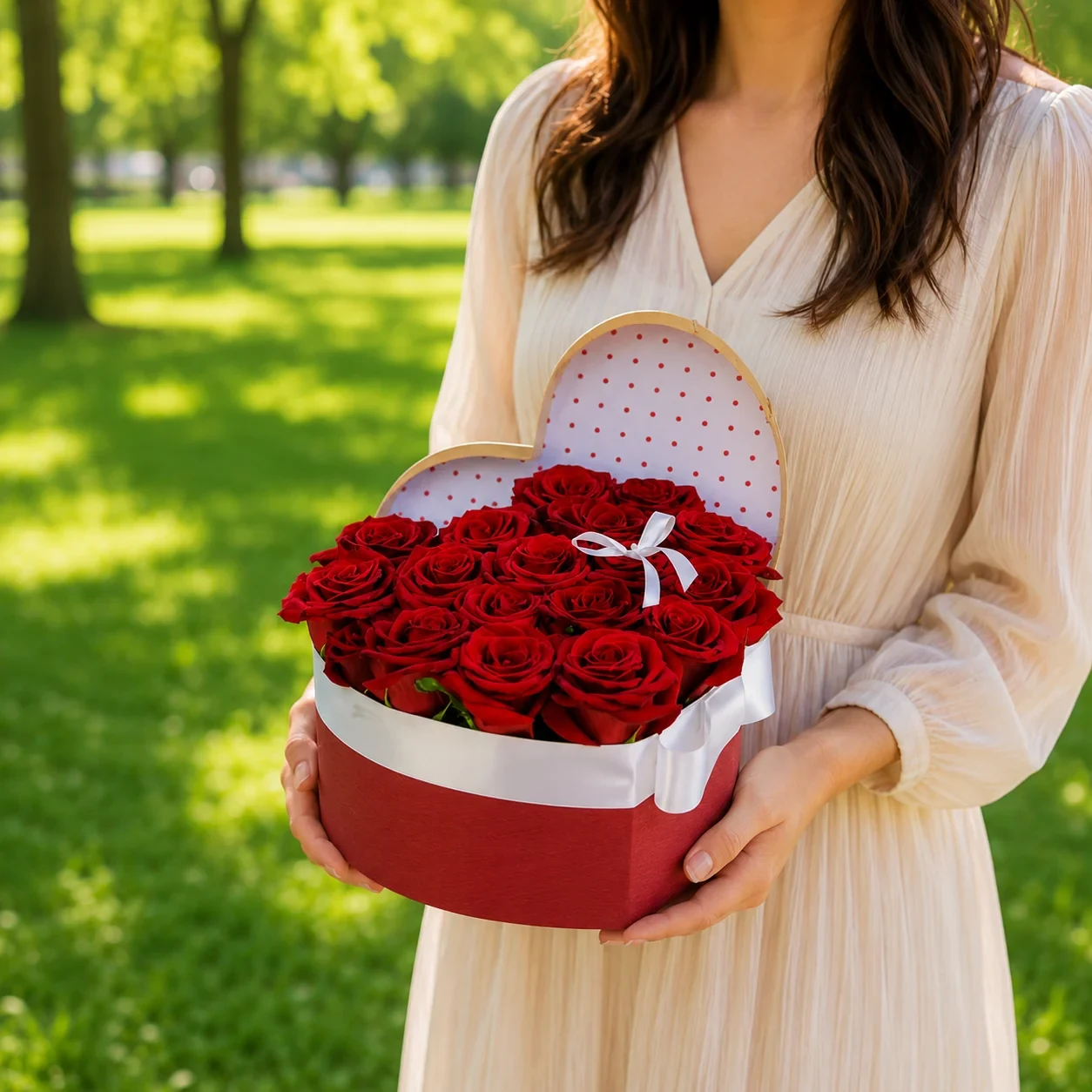
21 Red Roses in a Heart Box: Love in Its Most Elegant Form
After thirty years in this trade, I can tell you that roses arranged in a heart-shaped box are among the compositions we take the most care with in my workshop. Unlike a traditional bouquet, the 21 Red Roses in Heart Box arrangement places the roses tightly and evenly within a compact heart form. This presentation is visually striking, and because the roses lean on and support one another, they actually travel better than loose stems. Choosing 21 red roses is never accidental; the number and the color together carry a powerful message of devotion.
General Characteristics and Origin of the Red Rose
The red rose belongs to the genus Rosa and has been cultivated for thousands of years. The roses we grow in our Antalya greenhouses are usually hybrid varieties of Dutch and Ecuadorian origin, chosen for both color saturation and vase life. The roses used in heart boxes are typically dense-petaled varieties with shorter stems, since they are arranged horizontally inside the box.
Light and Placement
Because the roses in a heart box are cut flowers rather than a rooted plant, they don't need sunlight to grow, but they absolutely must be kept away from direct sun and heat sources like radiators. The ideal spot indoors is a shaded, cool corner with good air circulation. Placing the box on a windowsill, especially during midday hours, causes the petals and leaves to wilt rapidly.
Temperature and Humidity
The ideal ambient temperature for roses is between 15 and 20 degrees Celsius. Since the water reservoir in a heart box is limited, moisture loss happens much faster in hot, dry environments. Roses kept in an air-conditioned, moderately cool room will last considerably longer than those kept in a warm kitchen or a sun-drenched balcony. If possible, moving the box to a cooler room at night noticeably extends its lifespan.
Watering and Tips to Extend Vase Life
Most heart-box roses are presented with a small hidden floral foam or water reservoir. This foam should be kept consistently moist but never drowning; excess water leads to rot at the stem base rather than the roots. From experience, a few simple habits make a real difference:
- Check the foam daily and moisten it with lukewarm water when dry, never pour water heavily onto it.
- When you open the box, inspect the cut ends of the stems; if they look darkened, ask your florist how to refresh them.
- Keep the box away from direct sunlight, air-conditioning vents, and fruit bowls, since ripening fruit releases ethylene gas that accelerates flower aging.
- Keep the box on a flat, stable surface and avoid moving it frequently, as roses are sensitive to impact.
- Gently check the petals each day and remove any that have started to wilt, which keeps the remaining roses looking fresher.
Pruning and Post-Bloom Care
Since heart-box roses are already trimmed to a shorter stem length before arrangement, you won't need to prune them again at home, as we prepare this for you in the workshop. However, once the petals begin to fade, both the box and the roses can be kept as a dried-flower keepsake; simply turn the roses upside down and hang them in a cool, dark place to dry naturally.
Gift Meaning and Common Mistakes
The red rose is the universal symbol of passionate love and deep devotion, while the number 21 represents complete and lasting affection in many cultures. The heart box format is especially favored for anniversaries, proposals, and Valentine's Day. A common mistake is closing the box lid tightly right after receiving it; roses need airflow, so the box should be kept open or partially open. Another mistake is placing the box directly on top of a television or other electronic device, which generates heat. Pay attention to these small details, and your 21 Red Roses in Heart Box will stay fresh and striking for days, just as beautiful as the moment it was first opened.

Florist with 30 years of experience. Lives in the Antalya region and shares practical flower-care knowledge.